
TL;DR
Treating corporate transactional structures as an afterthought routinely drains up to 7% of corporate revenue in trapped liquidity and hidden operational fees. Intermediaries who proactively design a multi-currency account architecture instead of a generic banking referral secure their position as indispensable cross-border advisors. This post provides the structural frameworks and compliance blueprints required to architect global treasury routing before approaching any provider.

In the international company formation and wealth structuring, the transactional architecture is frequently relegated to a late-stage operational box. Advisors habitually arrange a simple referral to an external financial institution, viewing money movement as a secondary administrative utility. In the current global landscape, this late-stage, generic configuration is directly damaging to corporate value. Sophisticated corporate service providers, fiduciaries, and international tax lawyers recognize that corporate cash management must be deliberately architected prior to the incorporation of the first legal entity.
When multi-entity legal structures are established across complex corridors like Malta, Cyprus, the UAE, and the UK, operational velocity relies entirely on financial design. Entrusting cross-border transactions to rigid, legacy banking systems introduces severe frictions. By contrast, a forward-looking intermediary coordinates a native digital infrastructure that preserves client capital, automates multi-jurisdictional compliance, and scales across distinct borders without friction.
Why Is a Traditional Account Structure Insufficient for Complex Multi-Entity Operations?
Traditional structures isolate corporate data from transaction lines, systematically trapping approximately 7% of annual enterprise revenue within the value chain. Legacy settlement infrastructure relies on asynchronous batch processing and restricted operating windows, creating systemic liquidity delays that stall cross-border operations.
When a corporate client operates globally, a traditional single-currency account enforces immediate, non-strategic currency conversions on inbound international transfers. These conversions typically incur arbitrary foreign exchange spreads ranging from 2% to 5% worse than mid-market rates. Furthermore, hidden correspondent handling fees routinely deduct unspecified intermediary amounts from processing lines, leaving payments short due to opaque transaction routing.
To prevent this capital erosion, a multi-currency account must be defined precisely as a core digital infrastructure mechanism that enables a single corporate profile to natively receive, hold, and deploy capital across multiple international fiat currencies—such as USD, EUR, and GBP—without triggering mandatory currency conversion or relying on fragmented local banking portals.
Without this centralized architectural layer, cross-border businesses must manage a highly disjointed ecosystem of local financial relationships across multiple jurisdictions. This fragmentation breeds severe data silos, creates immense visibility gaps for treasury departments, and exposes the corporate group to unmitigated foreign exchange volatility.
How Can Corporate Service Providers Design a Defensible Multi-Currency Account Architecture?
A defensible multi-currency layout mandates a multi-rail platform approach that separates core legal entities from restricted transaction nodes and routes cross-border flows directly through local real-time clearing networks. Instead of directing a client to a single legacy provider, fiduciaries must implement an integrated digital dashboard that unifies dedicated corporate IBANs across multiple regions.
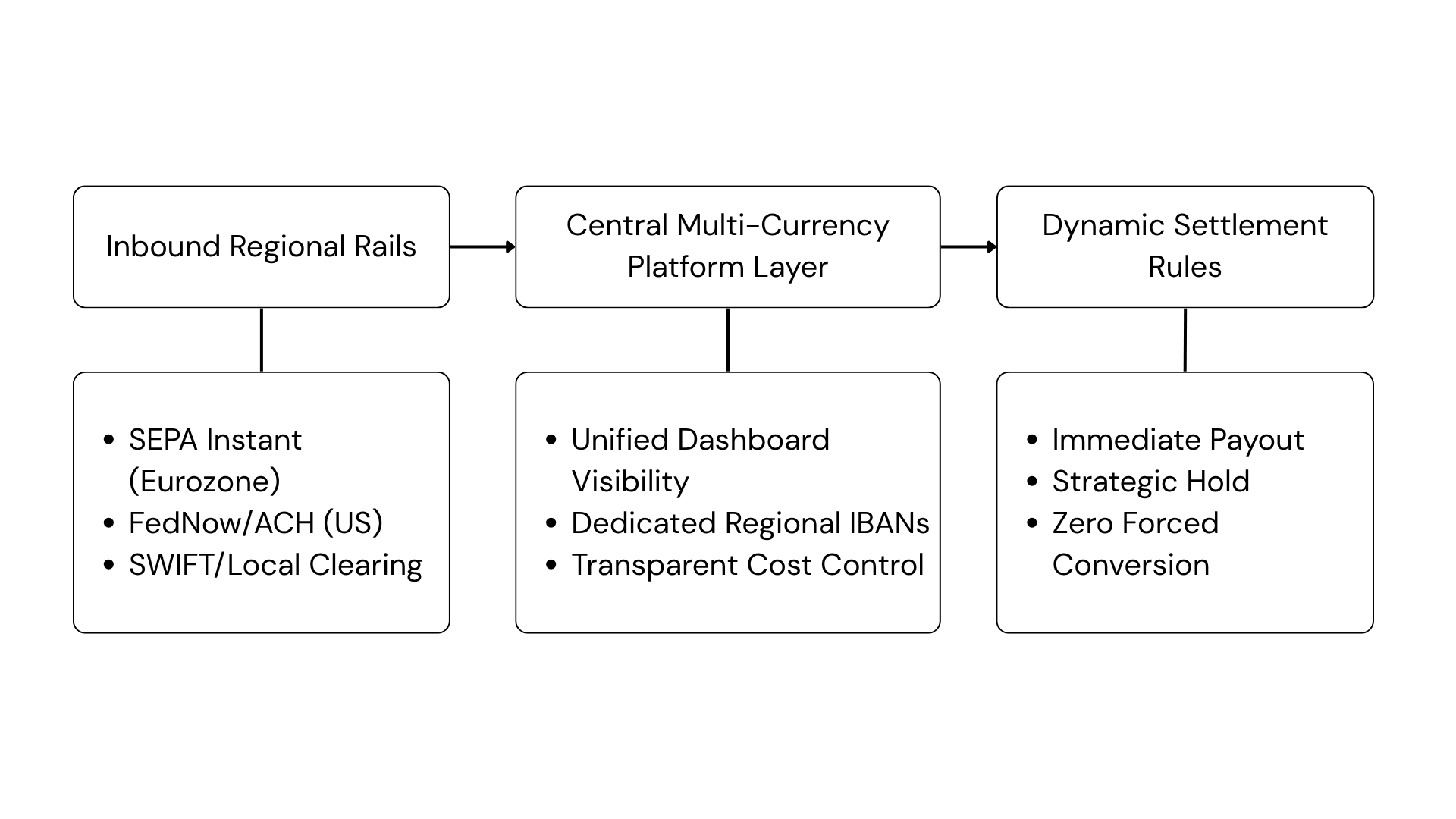
To structure this flow effectively, intermediaries should evaluate providers against a strict operational capability framework:
When advising multi-entity operations, structural architects must follow a rigorous five-step financial modeling methodology to ensure maximum cost normalization:
- Transaction Cohort Segmentation: Group the client's global payment flows by geographical corridor, transaction volume, and transaction frequency to identify high-value flows.
- Platform Take-Rate Auditing: Audit the exact fees applied across specific clearing rails, including ACH, card rails, and real-time settlements, to calculate net margins.
- Structural Leakage Evaluation: Model the financial impact of temporary retention with legacy providers during transition periods to predict cash-flow velocity.
- Compliance Opex Calculation: Integrate fixed and variable costs associated with Know Your Customer (KYC) and Anti-Money Laundering (AML) transaction processing to preserve realistic margin expectations.
- 3-Year Net Present Value Projection: Compute the 3-year Net Present Value (NPV) of the optimized transactional stack to quantify the direct enhancement to the client's enterprise valuation.
What Role Does Real-Time Data and Regulatory Compliance Play in Modern International Structures?
Automated regulatory compliance must be integrated natively into the core financial architecture to execute transaction screening without introducing operational friction or causing settlement bottlenecks. Historically, satisfying complex KYC and global AML screening parameters functioned as a major barrier to cross-border capital movement.
For instance, within the Eurozone, the transition to stricter instant settlement timeframes requires transaction screening to occur within compressed windows. Legacy screening processes frequently yield false positives, triggering a high transaction decline rate ranging from 1% to 15% of total instant volumes across cross-border corridors.
To bypass these delays, modern multi-currency account structures incorporate advanced financial messaging data requirements like the ISO 20022 format. This global standard eliminates unstructured text fields, allowing automated transaction screening systems to instantly verify counterparty identities. Transitioning to this messaging architecture automates up to 84% of manual exceptions and payment investigations, significantly lowering operational costs and protecting the structure against compliance risks.
The Blueprint of a Financial Architecture
Consider the practical requirement of a boutique fiduciary firm managing a corporate client in the shipping and e-commerce distribution vertical. The client maintained production entities in the UAE, a centralized holding vehicle in Malta, and international suppliers across the Asia-Pacific region.
- The Problem: Under the client's original setup, inbound payments from international retail corridors required five to seven business days to clear, trapping capital and forcing the group to secure costly short-term loans to fund working capital. Every inbound transfer triggered automatic currency conversion into local fiat currencies at retail rates, eroding profit margins by an average of 2% to 4% per transaction.
- The Architectural Fix: The fiduciary designed a centralized multi-currency account infrastructure utilizing dedicated regional IBANs. This layout allowed the corporate group to collect USD and EUR directly, segregate balances by currency, and settle obligations directly with international suppliers via regional clearing systems without forced conversion.
- The Quantifiable Outcome: By replacing legacy banking referrals with a deliberate multi-rail layout, the client's overall working capital processing cycle was reduced by approximately 50%. Total annual transaction opex dropped significantly, hidden conversion fees were eliminated, and the client established complete visibility over their real-time cash position through a single digital platform interface.
Connected Financial Architectures Form the Ultimate Economic Moat
The transition from a passive entity creator to a strategic financial architect marks the definitive boundary of modern global advisory leadership. As digital platforms and unified transactional networks claim an increasing share of international enterprise revenues, standard banking referrals are no longer defensible. Clients require continuous, real-time data integration, complete multi-currency control, and total cost transparency across every operating market.
Intermediaries who embed these capabilities directly into their structuring advisory pipeline insulate their clients against market volatility while building an elite, institutional moat. The ultimate objective is clear: transform the corporate treasury from an administrative burden into a high-yield operational lever.
*Disclaimer: This guide is provided for informational purposes only and does not constitute legal, tax, or regulatory compliance advice. Intermediaries and corporate enterprises must consult qualified professionals to evaluate their specific cross-border compliance structures.
FREQUENTLY ASKED QUESTIONS
Q: What is the typical timeframe required to deploy a multi-currency account infrastructure for international corporate structures?
A: Utilizing pre-built financial infrastructure and API layers allows fiduciaries to launch a dedicated transactional hub for corporate groups in as little as four to six weeks. This acceleration bypasses the typical 18-month timeline required to engineer and approve a custom, internal core setup from scratch.
Q: What are the primary variables that dictate foreign exchange costs within an international business structure?
A: Foreign exchange costs are driven by cross-border transaction volume and the specific spread margin applied to currency pairs, which typically hovers between 0.5% and 1.5% on modern platforms. By employing dedicated multi-currency architectures, corporations avoid forced conversions and capture spreads that traditional institutions typically monopolize.






















.jpg)





.jpg)




.jpg)
.jpg)
.jpg)