
TL;DR
The design of team permission architecture can affect how a complex group structure manages security, access controls, and operational workflows as it scales. Relying on basic, all-or-nothing user roles may increase compliance and treasury-control risks for some cross-border entities. Advisors must evaluate platform-level permission granularity to ensure centralized governance doesn't compromise local operating entity autonomy.

When structuring international corporate groups, structural architects and accounting firms focus heavily on corporate tax optimization and jurisdictional compliance. However, the operational reality often breaks down at the transactional level if the underlying financial platform cannot handle complex corporate hierarchies. Evaluating team permission architecture multi-entity financial platform advisor frameworks is not an administrative afterthought; it is a core operational requirement. Without granular, multi-layered access controls, centralized finance teams may face additional operational friction or elevated security risks, depending on their structure and controls. This guide details how to build and audit a robust permission framework across distributed corporate groups.
Establishing a secure environment requires moving past standard corporate accounts that treat an entire group as a single monolith. For corporate service providers (CSPs) and tax lawyers advising cross-border enterprises, assessing platform-level permissions can help support asset-protection controls and operational efficiency.
Why does permission architecture matter when advising a multi-entity group on financial platform selection?
Recommending a financial platform without reviewing its permission infrastructure may create a structural vulnerability. In multi-entity corporate groups, centralized treasury functions need macro-level visibility, while local operating directors require micro-level transaction capabilities. If a platform lacks localized configuration options, the corporate group faces a broken operational paradox: they must either give local managers complete access to group funds or force the parent company's CFO to manually sign off on every low-value office expense.
According to data from the PwC 2025 Global Treasury Survey, 48% of corporate treasurers highlight operational risk management and internal transaction controls as their top operational concerns. A poorly designed user framework directly amplifies these risks. When a single set of credentials gives inappropriate visibility into another entity’s balances, the group’s internal access-control framework may be compromised. Proper governance generally requires clear segregation of duties at the legal entity level, reflected consistently within the digital interface.
Advisors must understand that the wrong framework creates a choice between over-restriction and total governance exposure. When financial systems lack flexibility, teams inevitably share passwords or bypass approval chains to get work done. Effective security aims to support day-to-day work while maintaining strong institutional oversight.
What is a role-based access framework and how does it apply to multi-entity financial operations?
A role-based access financial platform multi-entity business structure ensures that user permissions are tied directly to an individual's explicit corporate function, rather than their identity. Instead of configuring unique rules for every new employee, corporate administrators assign pre-defined role templates—such as Treasury Manager, Subsidiary Accountant, or Local Director—that carry immutable access parameters.
This systematic approach prevents permission creep, which occurs when employees accumulate system access rights as they transfer between different entities or projects. In a complex group structure, a single user might require "View Only" access for the parent company’s consolidated cash reporting, but "Full Administrator" rights for a specific localized operating entity.
By implementing a standardized, role-based configuration, advisors ensure that corporate compliance policies are enforced programmatically. This reduces the administrative burden on internal IT teams and provides a transparent, standardized blueprint that external auditors can easily verify during annual governance reviews.
What permission architecture decisions are most important for multi-entity group structures?
Designing a resilient system requires balancing localized operational agility with centralized corporate oversight. When setting up financial controls complex group structure advisor teams must guide clients through four definitive structural choices rather than leaving settings at default levels.
How should entity-level and group-level access be configured for a multi-entity holding structure?
The structural blueprint must isolate entity-level data while supporting centralized group aggregation. A group CFO based in London requires unrestricted visibility across all multi-currency account structures to manage global liquidity efficiently. Conversely, a regional manager running an operating subsidiary in Cyprus must be strictly cordoned off within that specific entity’s environment. Setting up independent workspace boundaries can help reduce the risk that a security compromise or regulatory freeze in one jurisdiction disrupts operations across the entire corporate group.
How do approval hierarchies need to be configured for distributed finance teams in a multi-entity group?
Transaction approval chains must dynamically match the financial weight and geographic origin of individual payments. Instead of relying on a single signer, complex groups require conditional payment approval architecture that scales according to transaction value. For example, local transactions under €10,000 can clear with a single local accountant’s approval. Any cross-border payment exceeding €50,000 might programmatically require dual authorization: one from the local managing director and a final sign-off from the group treasury director. This prevents unauthorized capital flight while allowing day-to-day procurement to proceed without delay.
What should advisors evaluate when assessing a financial platform's permission architecture for a complex group client?
When evaluating third-party corporate platforms for international clients, advisors must look past marketing promises and thoroughly audit five core system capabilities:
- Entity-Level Permission Granularity: Can a single user profile hold completely different, independent sets of access rights across separate subsidiaries under the same corporate umbrella?
- Role Configurability: Can the corporate administrator create custom roles with tailored parameters, or is the company limited to basic, rigid templates like "Admin" and "User"?
- Approval Workflow Depth: Does the system support multi-stage, conditional approval hierarchies that scale seamlessly based on transaction amounts, currency types, and destination countries?
- Audit Trail Quality: Does the platform maintain exportable audit logs for key user actions—such as login locations, permission modifications, and transaction drafts—for compliance checks?
- Account Management Responsiveness: When a group structure changes during a corporate restructuring, can team permissions business account multi-entity settings be adjusted quickly via a dedicated account manager, or does it require a lengthy support ticket process?
A platform's ability to restrict card issuance permissions is another critical component. Corporate treasuries frequently run into trouble when local teams spin up uncontrolled payment instruments. Systems should allow administrators to set spending controls on virtual cards, helping local units deploy cards within group-level budget parameters, subject to eligibility, compliance checks, and platform availability.
What does a well-configured permission architecture look like for a holding group with three entities across two jurisdictions?
To understand how these rules may work in practice, consider an anonymized illustrative multi-jurisdictional structure that could be configured on a platform. In this illustrative example, a holding company registered in Malta owns an operating e-commerce logistics subsidiary in Cyprus and a marketing entity based in the UAE.
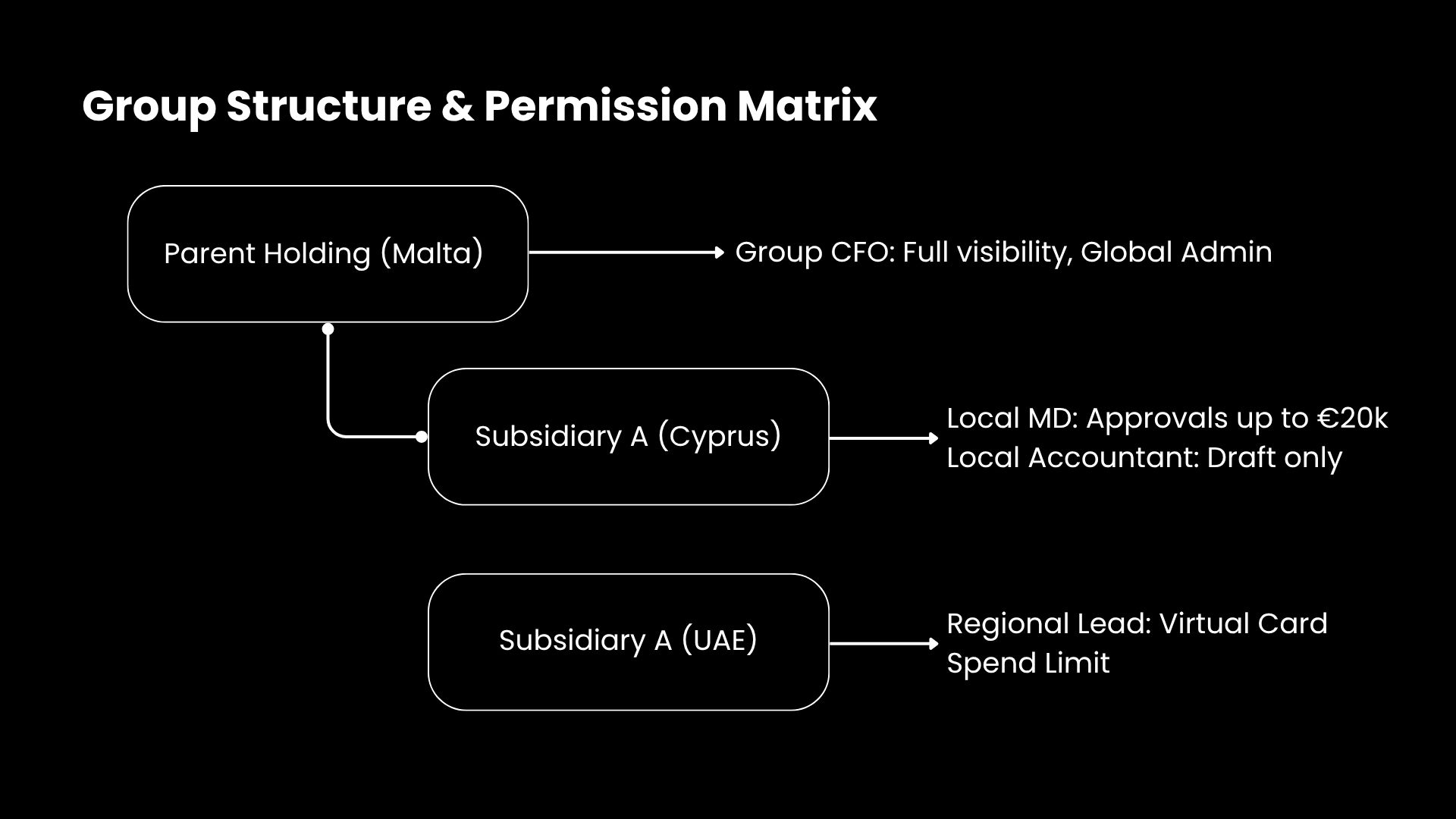
The organization's team permission architecture multi-entity financial platform advisor layout is configured as follows:
- The Malta Parent Company: Access is restricted to the Group CFO and Senior Treasury Partners. They hold master administrative rights, allowing them to monitor aggregate cash flows across all multi-currency accounts, allocate capital between subsidiaries, and modify group-level risk parameters.
- The Cyprus Operating Entity: The local Managing Director holds localized signing authority for transactions up to €20,000. The local operations team can draft outbound SEPA payments, but the system prevents them from executing transfers until an authorized signer reviews the data.
- The UAE Marketing Entity: The regional marketing lead has no visibility into the Malta or Cyprus accounts. They are assigned a local profile with permission restricted to issuing and managing virtual cards for digital advertising spend, capped at a maximum of $15,000 per month.
By establishing this specific matrix, the group reduced certain internal fraud risks and supported more automated month-end close reporting. The parent company maintains complete institutional control, while the regional subsidiaries possess all the operational tools required to run their day-to-day regional tasks without interruption.
CONCLUSION
Building a secure corporate structure requires looking closely at how money moves between different entities on a day-to-day basis. Recommending a corporate financial platform that lacks granular, role-based access rights leaves clients vulnerable to operational bottlenecks and costly compliance errors.
A well-designed team permission architecture protects multi-entity businesses from internal friction and external security threats. By taking the time to design clear approval chains, set strict entity-level boundaries, and enforce robust user roles, advisors help their clients build a scalable financial foundation that can handle international expansion safely.
*Disclaimer: This guide is provided for informational purposes only and does not constitute legal, tax, or regulatory compliance advice. Intermediaries and corporate enterprises must consult qualified professionals to evaluate their specific cross-border compliance structures.
FREQUENTLY ASKED QUESTIONS
Q: How do team permissions prevent internal fraud in a multi-entity business account?
A: By enforcing a strict segregation of duties through role-based access controls, a platform ensures that no single user can initiate and execute a transaction completely independently. Forcing a clear separation between payment creators and payment approvers programmatically blocks unauthorized capital transfers.
Q: Can a user have different access levels for different subsidiaries within the same corporate group?
A: Yes, an advanced multi-entity financial platform allows an individual user profile to hold isolated permissions across different corporate workspaces. A user can be granted full transaction execution capabilities in an operating subsidiary while remaining restricted to view-only access within the holding entity.
Q: What happens to team permission settings during a corporate restructuring or entity disposal?
A: When an operating subsidiary is divested or restructured, a master administrator can instantly revoke or transfer all entity-specific user privileges from the central control panel. This immediate decoupling ensures that former employees or local directors lose access to corporate financial systems right away.






















.jpg)





.jpg)




.jpg)
.jpg)
.jpg)