
TL;DR
SEPA Instant has evolved from a consumer convenience into a useful option for structuring some corporate EUR payment flows. Under the EU Instant Payments Regulation mandates and European Payments Council rulebook updates, SEPA Instant is designed to support near-real-time EUR settlement, which may reduce processing float and improve working-capital availability where both institutions are reachable and compliance checks are completed. Intermediary advisors may consider integrating SEPA Instant into client payment routing frameworks where appropriate to help reduce certain EUR settlement delays and improve intraday liquidity management.

When designing corporate financial architecture for cross-border group structures, payment rail selection is frequently treated as an operational afterthought. Clients are routinely defaulted to standard clearing channels without an evaluation of how settlement delays impact working capital, treasury management, and counterparty trust. For corporate service providers, fiduciaries, tax attorneys, and accounting firms advising international operating entities, structuring EUR payment flows requires a more deliberate approach. Incorporating SEPA Instant B2B payments into client operational frameworks can help make eligible EUR transactions faster and more predictable than standard batch-based clearing.
As the European Union’s Instant Payments Regulation is implemented, SEPA Instant is expected to become more widely available for eligible euro-area transfers, alongside standard SEPA clearing. Advising clients on when and how to deploy SEPA Instant may help support EUR cash-management goals such as reducing capital lock-up, supplier friction, and operational delays where the payment is eligible.
What is SEPA Instant, and how does it differ from standard SEPA for B2B payments?
Evaluating payment architecture requires a clear technical understanding of how SEPA Instant Credit Transfer (SCT Inst) differs from standard SEPA Credit Transfer (SCT) across four critical operational parameters:
- Settlement Speed: Standard SEPA operates on a next-day or batch-processing cycle (D+1 execution), meaning funds sent on Friday afternoon routinely do not settle until Monday or Tuesday. In contrast, SEPA Instant executes transactions end-to-end within 10 seconds. According to the Mambu EPC 2025 SEPA Rulebook Updates, updated execution frameworks include strict 5, 7, and 9-second technical benchmarks alongside millisecond-precision DateTime timestamps to support faster execution for eligible transactions.
- Operational Availability: Standard SEPA clearing is bound by interbank cut-off times and operates strictly on business days. SEPA Instant functions continuously—24 hours a day, 365 days a year—unaffected by weekends, public holidays, or regional cut-off windows.
- Transaction Limits: While the initial scheme framework imposed a default cap of €100,000 per transaction, regulatory evolution and institutional participant agreements increasingly permit higher custom thresholds for corporate use cases.
- Settlement Finality and Recall Rules: Standard SEPA transfers can sit in pending processing states, exposing corporate treasury teams to administrative ambiguity. For successfully executed eligible transactions, SEPA Instant provides rapid settlement finality. Furthermore, updated EPC guidelines restrict post-settlement recall procedures to a single attempt per transaction, significantly reducing operational uncertainty for corporate payees.
When is SEPA Instant the right payment rail for a client's EUR B2B payment flows?
Not every business transaction demands sub-10-second execution, but specific corporate payment scenarios derive measurable financial value from immediate settlement:
- Time-Sensitive Supplier & Vendor Payments: Releasing bills of lading, customs releases, or critical software deployment keys upon verified receipt of funds.
- Same-Day Cross-Border Payroll & Contractor Disbursements: Executing urgent payroll funding to regional operating subsidiaries or international contractors without incurring 48-hour processing holds.
- Fiduciary & Escrow Disbursements: Facilitating immediate transaction completions in M&A deals, corporate restructurings, real estate closings, or board-approved dividend distributions.
- Intercompany Treasury Movements: Rebalancing intraday cash balances across European subsidiaries to optimize cash positioning without relying on overnight credit facilities.
Hypothetical Intermediary Example:
A corporate service provider in Malta manages a mid-market international group with operating entities in Cyprus, the UAE, and the UK. The group frequently purchases physical inventory from European manufacturers, requiring immediate payment to release shipments. Under standard SEPA clearing, transfers sent on a Friday afternoon may not settle until the next business day or later, which can delay shipment release.
In an eligible scenario where both institutions support SCT Inst and screening is completed automatically, a SEPA Instant transfer may settle within seconds, including outside normal business hours. In some cases, faster settlement may help accelerate dispatch and reduce reliance on short-term working-capital arrangements, depending on supplier processes and transaction eligibility.
What working capital benefit does SEPA Instant create for clients with high EUR payment volumes?
The primary economic argument for instant settlement lies in cash optimization. The Capgemini World Payments Report 2025 notes that inefficient cash management and limited real-time visibility cost businesses nearly 7% of their annual revenue in trapped liquidity.
Eliminating processing float allows corporate treasurers to maintain lower cash reserves in low-yield operational accounts and redeploy capital directly into revenue-generating activities.
What are the cost considerations for recommending SEPA Instant over standard SEPA?
Under the European Central Bank Instant Payments Regulation framework, financial institutions in the euro area cannot charge transaction fees for instant euro payments that exceed the fees charged for standard credit transfers.
When advising clients, advisors must weigh transaction charges against the hidden operational costs of delayed clearing. For some corporate transfers, advisors should compare transaction charges, platform service costs, reconciliation benefits, and the working-capital impact of faster cash availability before recommending SEPA Instant.
What limitations should advisors be aware of when recommending SEPA Instant?
While SEPA Instant provides substantial efficiency gains, advisors must account for specific operational constraints:
- Counterparty Reachability: Both the originating and receiving institutions must participate in the SCT Inst scheme. Although EU mandates require widespread institution reachability across euro-area member states by late 2025, non-euro zone jurisdictions or smaller institutions may exhibit uneven participation.
- Scheme Amount Caps: The default scheme cap of €100,000 per transaction remains enforced by certain intermediary rails unless customized institutional arrangements are established.
- Automated AML & Compliance Screening: Because settlement occurs within seconds, traditional manual compliance delays are unfeasible. Transactions are processed via real-time automated screening engines. If a transaction flags complex sanctions or ownership anomalies, it will drop out of instant execution into manual review, reverting to standard processing timelines.
How does SEPA Instant fit into a broader payment routing framework for a multi-currency client?
SEPA Instant should not exist in isolation; it must be incorporated into a holistic, policy-driven payment routing matrix alongside local rails and global messaging networks.
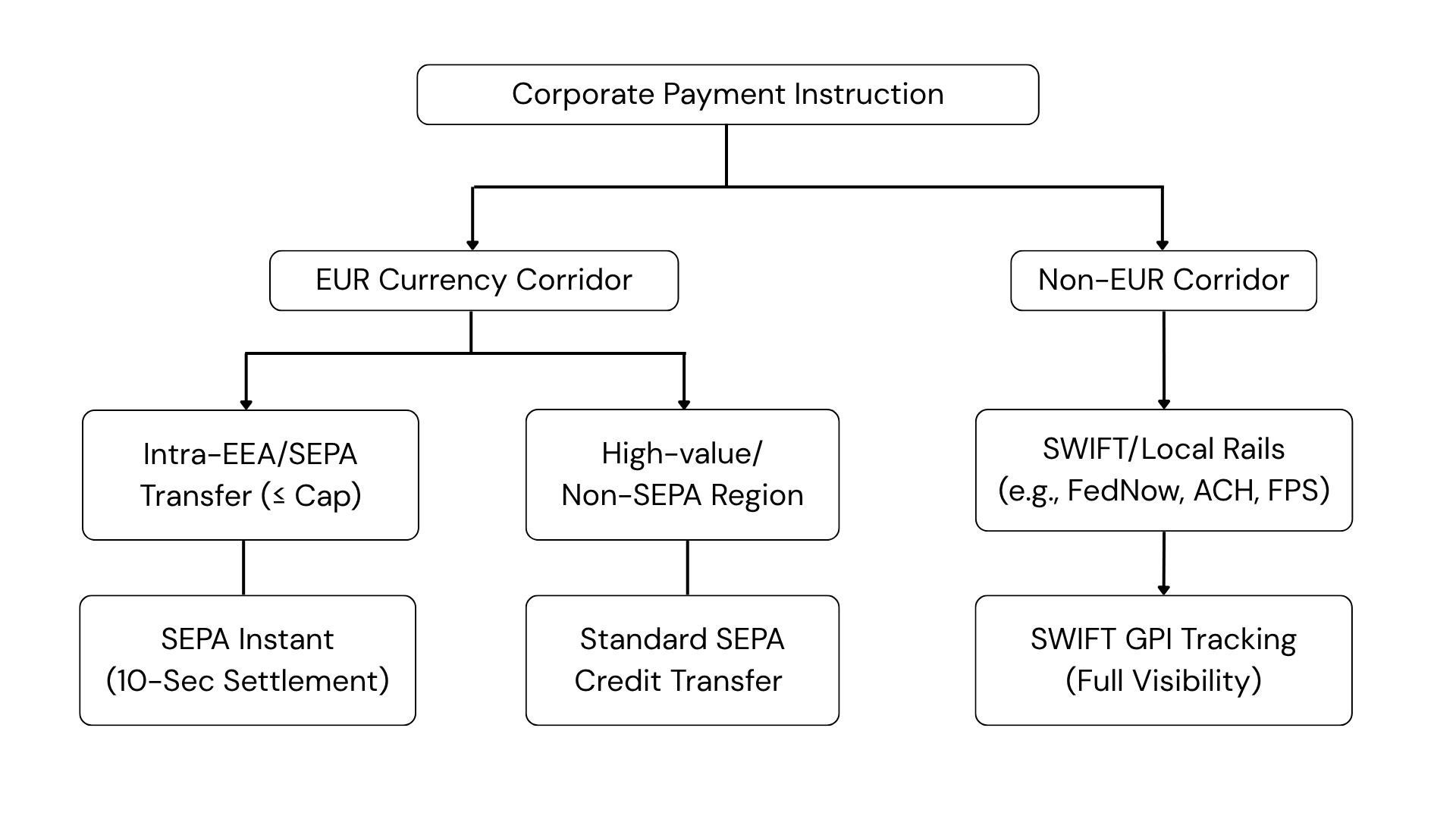
Recommended Default Payment Routing Matrix:
- EUR Intra-EEA Transfers (up to transaction limits): Route via SEPA Instant as the default option for immediate settlement and real-time vendor reconciliation.
- EUR High-Value Batch Payments / Non-Urgent Distributions: Route via Standard SEPA Credit Transfer if transaction caps are exceeded or if batch processing aligns with ERP workflows.
- Non-EUR or Out-of-Scope Geographic Corridors: Route via SWIFT, supported by SWIFT GPI Tracking for end-to-end status visibility and fee transparency.
- Domestic Non-EUR Operations (e.g., USD, GBP): Route via dedicated local clearing networks (such as Faster Payments in the UK or FedNow/ACH in the US).
What should advisors verify when checking whether a financial platform supports SEPA Instant properly for B2B use?
Intermediary advisors evaluating platforms for client deployment must verify three critical criteria:
- Native ISO 20022 Compliance with Millisecond Precision: Confirm that the platform generates structured ISO DateTime timestamps down to valid milliseconds. This ensures frictionless communication across European clearing networks and prevents transaction rejections.
- True 24/7/365 Execution Architecture: Verify that transactions are cleared continuously without hidden platform cut-off times, weekend processing queues, or batch holds.
- Dedicated Intermediary Support: Ensure the provider furnishes direct account management support capable of handling edge cases, instant payment status tracking, and R-message exception management in real time.
CONCLUSION
Structuring an optimized international corporate footprint requires advisors to evaluate how money moves, not just where accounts are established. Incorporating SEPA Instant B2B payments into client operating structures transforms EUR clearing from a delayed, passive process into an active driver of working capital efficiency, operational speed, and risk reduction. Intermediary advisors who proactively embed instant payment routing policies into their structural recommendations deliver concrete economic advantages that protect margins and strengthen client resilience.
*Disclaimer: This guide is provided for informational purposes only and does not constitute legal, tax, or regulatory compliance advice. Intermediaries and corporate enterprises must consult qualified professionals to evaluate their specific cross-border compliance structures.
FREQUENTLY ASKED QUESTIONS
Q: Can SEPA Instant be used for cross-border EUR payments outside the EU?
A: Yes, provided the destination institution is located within the geographic SEPA zone—which encompasses 36 participating countries, including non-EU member states such as the UK, Switzerland, and Norway—and is actively participating in the SCT Inst scheme.
Q: What happens if a SEPA Instant transaction fails or cannot settle within 10 seconds?
A: If a SEPA Instant transaction cannot be completed within the mandatory technical timeframe due to system timeouts, network unavailability, or unreachability, the transaction is rejected. Funds are immediately returned to the originator's available balance rather than remaining trapped in a pending clearing hold.
Q: Are European financial entities mandated to support SEPA Instant by 2026?
A: Yes. Under the EU Instant Payments Regulation, euro-area payment service providers that offer standard SEPA credit transfers are required, on applicable timelines, to support receiving and sending SEPA Instant transfers, increasing availability across participating European markets.






















.jpg)





.jpg)




.jpg)
.jpg)
.jpg)